While looking out a web based business administration, the essential names that come to considerations are ordinarily Shopify and BigCommerce.
Nonetheless, there's a web based business stage that plays as appropriate as them - and occasionally far better Storebuilder with the guide of utilizing Nexcess.
So on this post, we'll talk roughly StoreBuilders chief highlights, estimating and the method for getting everything rolling.
On the whole, because of the way that internet business is a gigantic, monstrous world, we should talk roughly the exceptional types of internet business frameworks out there.
Web based business Platforms
While attempting to advance on the web, your initial step is settling on an internet business stage. These designs explicitly aggregate into four kinds:
Web based business replies: they have simple to-involve interfaces that make placing in a web shop a touch of cake. The incredible example is Shopify. Nonetheless, they have bound customization choices.
Internet business commercial centers: here you get exorbitant volumes of net guests anyway on the worth of inordinate contest. A few models are Amazon and Ebay.
Custom internet business sites: structures like WooCommerce concoct various customization opportunity, but you believe a couple of level of coding capacities should apply them.
Web designers: preferably, they have the extraordinary of every universes: each of the favors of internet business answers and of custom web based business sites. Here is in which you'll find StoreBuilder through Nexcess.
five star web site facilitating organizations in 2022. A Liquid Web logo changed into based again in 2000 and hasn't quit creating because of the way that then, at that point. One of its most recent deliveries is StoreBuilder
StoreBuilder is an intuitive web webpage manufacturer for WordPress. You can advance virtual substance, real things or perhaps your contributions of their stores.
The manufacturer is particularly intended for WordPress and comprises of Woo Commerce modules. As a matter of fact, you may without issues relocate your cutting edge WordPress on line put something aside free of charge. What's more, on the off chance that through peril you at any point need to disappear StoreBuilder, as opposed to with Shopify or SquareSpace, you might take your web based business site with you!
One of the issues that make StoreBuilder ideal for fledglings and non-educated is it utilizes computerized reasoning to put out a shop totally one of a kind on your selling needs. That is on the grounds that they need your site to stick out!
Highlights
Dashboard
StoreBuilder has a cutting edge UX-accommodating dashboard.
As of late, Nexcess rolled out certain improvements to make the board extra open for amateurs. Be that as it may, for the ones currently cozy with the WordPress Classic Admin, the choice to return the change is additionally accessible.
Store Design
Layouts are planned chiefly for you. At the point when you signal up, the StoreBuilder will request that you a few requests know which design is higher for you.
Then you have whole design opportunity: you could tweak the shop on your enjoying, from custom variety ranges to popular textual styles and extra.
Organizing And Development Environments
Work and test your keep without upsetting your visit web site on the web. StoreBuilder gives one organizing environmental elements at the starter plan and you could add extra for a charge.
They moreover have Automated Testing on their facilitating plans, which makes specific everything moves along as expected.
Shrewd Sales And Performance Tools
Acquire important experiences that can assist you with settling on decisions about your web based business keep with their Sales Performance Monitor and Plugin Performance Monitor.
For instance, on the off chance that pay dropped when you made a site extrade, StoreBuilder will caution you so you could adapt.
Deals And Conversions
Make special and slice value codes to draw clients.
Offer selective installment frameworks on your clients along with PayPal, Stripe and cryptographic forms of money.
The StoreBuilder furthermore gives Recapture, a product that aids abandoned truck recuperation.
Clients can disappear suppositions and huge name appraisals.
Advance your items with virtual entertainment sharing.
Auto Scaling
Nexcess Cloud Auto Scaling keeps your site from dialing back decisively after which crashing after a sizable development in rush hour gridlock. This capability ensures your keep can adapt to occasional spikes and hold giving a fantastic client experience.
Each plan gets 24 hours in accordance with month of auto-scaling at no expense, and you'll be told of your use while you start its utilization.
Reconciliations
Incorporate with Amazon, Walmart, Facebook, and different web based business contributions to accomplish a large number of customers.
StoreBuilder has extra than 50,000 WordPress modules, along with Kadence Theme PRO and Kadence Blocks PRO to make dazzling present day on-line stores.
Backing And Resources
Nexcess offers visit, telephone, and electronic mail help all day, every day.
They moreover have YouTube recordings, weblog posts, an expertise base, or even a webcast that will help you to your excursion. When you buy an arrangement, you'll furthermore approach video instructional exercises legitimate out of your WordPress dashboard.
At long last, Nexcess has a whole arrangement of program based gear alongside a Global DNS Checker and a Unix Timestamp Converter that you could use at no expense.
More Features
Security: free SSL and wellbeing checking.
Add team individuals and control authorizations.
Server-feature storing worked in.
Estimating
Costs range in sync with the scope of webweb destinations you really want and the transmission capacity required. Remember, that despite the fact that they don't have a free preliminary, they truly do give a gamble free guarantee to 30 days.
StoreBuilder costs start at $19 in accordance with month. You likewise can select to pay every year, saving 2 months of cost. It comprises of one keep, 30 GB of capacity, and as much as 500 orders in accordance with hour.
You likewise can get it for nothing in the event that you have proactively got a Nexcess' web site facilitating plan (StoreBuilder is covered of their Starter and Creator Managed WooCommerce Hosting plans).
What's more, in the event that you've long past over the 24-hour limit of auto-scaling, you'll be charged $.10 in accordance with minute in 30-minute augmentations, with a $three negligible charge.
In the event that you need extra, you can improve to their author plan, which costs $79 in accordance with month. It comprises of Beaver Builder Page Builder, twofold the stockpiling, and up to 3 stores.
HostGator is an excellent web hosting service that's simple to use and offers an array of useful plans for consumers and small businesses. It's our top pick for shared web hosting and for novice webmasters in general.
Keyword research is a crucial element of modern SEO. Whether you’re kick-starting an old blog or developing your content strategy for a new one; good quality keywords are one of the most efficient ways to attract consistent, quality traffic to your site. We’ve compiled a list of some of the best keyword research tools to help you conquer your content.
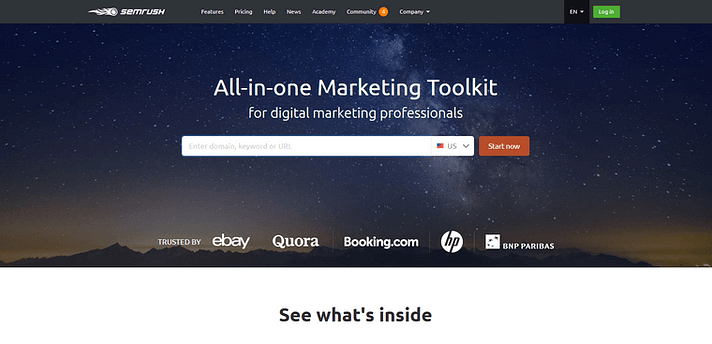
SEMrush is not just a keyword tool, it is like the Swiss Army Knife of SEO. Instead of producing a list of keywords, SEMrush suggests 5-10 very specific keywords that your competitors are already using.
Standout features
Uncover long-tail keywords and ad group ideas
Get yearly keyword trends
Worldwide CPC distribution statistics
Access to the complete keyword research toolkit
Keyword difficulty analysis and organic traffic insights
Pricing
SEMrush hosts a 7-day free trial of the service. You do need to enter credit card details to get access to the trial, but there are no charges levied if you choose to cancel your subscription within the 7-day trial.
SEMrush has four different pricing plans. The best offers come with annual billing.
Pro – A plan for limited budget sites and freelancers, it starts at $83 per month and gets billed annually.
Guru – SEO agencies and small to mid-sized business will find the features in this plan perfect for the day-to-day management of content sites. Guru starts at $166 per month.
Business – It is ideal for eCommerce stores and agencies, and opens at $333 per month.
Enterprise – If you have an extensive content strategy, reaching beyond the capacity of the above solutions, SEMrush can custom fit a plan for your needs.
2. KWFinder
KWFinder is a tool designed by Mangools – a developer known for delivering the best keyword research tools across categories. You can use their beginner guide to get started.
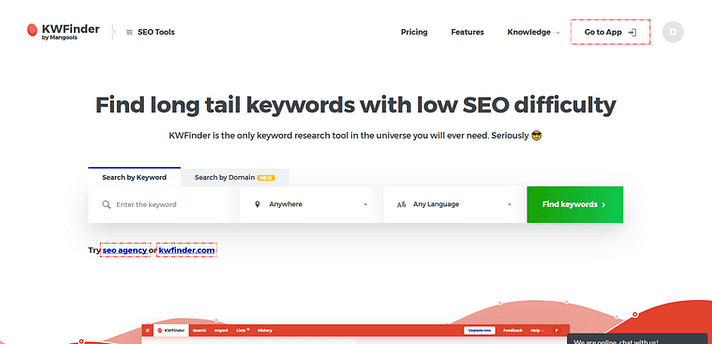
The KWFinder platform makes it easy to find keywords with low SEO difficulty, along with a whole host of other useful features.
Standout features
A unique and easy to navigate user interface
Find keywords in any language target, anywhere
Choose options from the list of powerful keywords
Get precise statistics for keyword competition
In-depth SERP overview alongside a list of suggestions
Use filters to refine the list of keyword suggestions
Pricing
KWFinder is part of Mangools package that includes 4 other SEO tools. This keyword tool only allows a handful of free searches. Select an annual plan to save up to 40% on any of their 3 subscriptions.
Basic – $30 (freelancers and small businesses)
Premium – $40 (new startups and blogs)
Agency – $80 (eCommerce stores and heavy sites)
3. Ahrefs Keyword Explorer
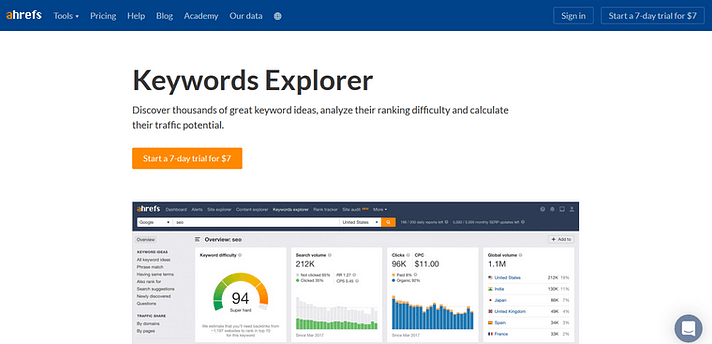
Ahrefs is one of the best keyword research tools available for content creators today. The platform provides a broad keyword report to the user and relies on clickstream data to provide unique click metrics.
Standout features
Accurate keyword difficulty score
1,000+ keyword suggestions
Supported in over 171 countries
Click metrics for improving CTR
Extensive SERP overview
Pricing
Ahrefs has four pricing plans. The rates for freelancers, online marketers, mid-sized organizations, and bigger brands start at just $82 per month if you choose an annual payment plan.
They do have a trial offer ($7 for 7 days) on their Lite and Standard subscription plans.
4. Google Keyword Planner
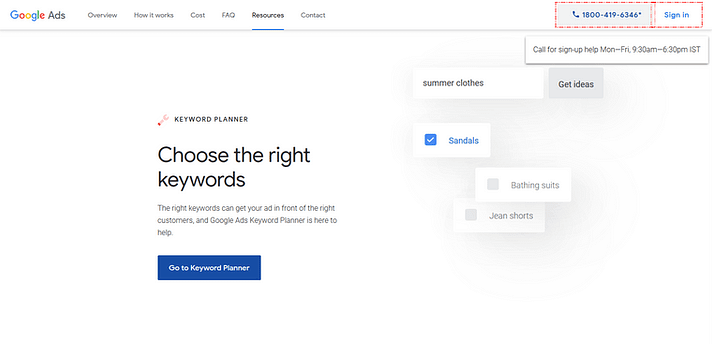
Google Keyword Planner is a simple keyword tool option serving up a few basic features. Despite the lack of functionality, however, it’s one of the most accurate sources of keyword data on the market. The data comes directly from Google and the results integrate well with AdSense monetization.
Standout features
Locate commercial keywords using “top of page” bid range
Accurate search volume directly from Google’s search engine
Best choice for business websites
Pricing
Google Keyword Planner is available for free.
5. GrowthBar
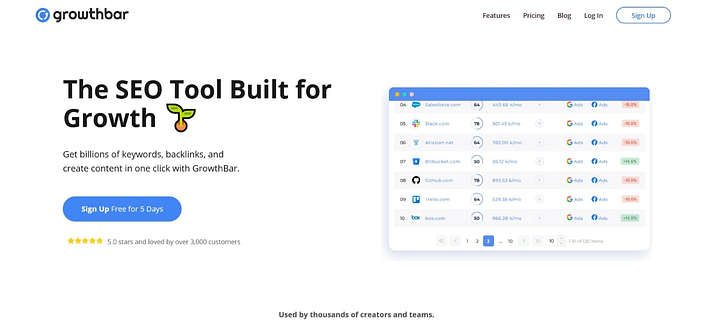
GrowthBar is a great tool for marketers and bloggers who are in a hurry, and want ranking difficulty or keyword suggestions to appear along with their search results.
A unique feature they recently added is content outline generation, you can use it to generate content outlines in one click for your blog or website with keywords, word counts, headers, images, links and more.
It also allows you to explore competitor’s profile featuring – backlink data, organic keywords, Google/Facebook ads info and related insights.
Standout features
Generate content outlines with AI
Keyword rank tracking
Accurate ranking difficulty
Long tail keyword suggestions
Exportable keyword data
On-page word count
Pricing
GrowthBar offer a free 5-day trial, after which you will be charged based on the plan you choose. The higher-tier plan will let you search unlimited keywords.
Pro – $29/month
Scale – $79/month
6. Long Tail Pro
It’s no secret that long-tail keywords are the new standard of SEO. Long Tail Pro keyword tool generates long-tail keywords for niche sites and has even found a cult following with content producers for micro-niche sites.
Standout features
Powerful, detailed keyword metrics
Easily find long-tail keywords
Provides recommendations for attracting highly convertible organic traffic
2,500+ SERP lookups every 24 hours
Pricing
Long Tail Pro is a premium tool and does offer a 7-days free trial (subscription to be cancelled before 7 days). Subscriptions start as low as $25 per month (when billed annually). Long Tail Pro currently offers three plans to users.
Starter – $25/month
Pro – $45/month
Agency – $98/ month
7. Majestic
Majestic is an all-in-one SEO tool to keep a track of your site’s health. It’s an ideal tool for new blogs and small businesses that don’t have the resources to invest a lot of complicated support for search engine optimization.
Standout features
All SEO features are available in a single toolkit
Find easy-to-target phrases
Research competition on each keyword
Trustworthiness vs. authority graph for website analysis
Pricing
Majestic allows you to sign up and run 3 free searches to help you get a feel for the service. The keyword checker, however, is only available in PRO and API plans. You can grab the SEO toolkit for $83/month when you select the annual billing option.
8. Keyword Tool
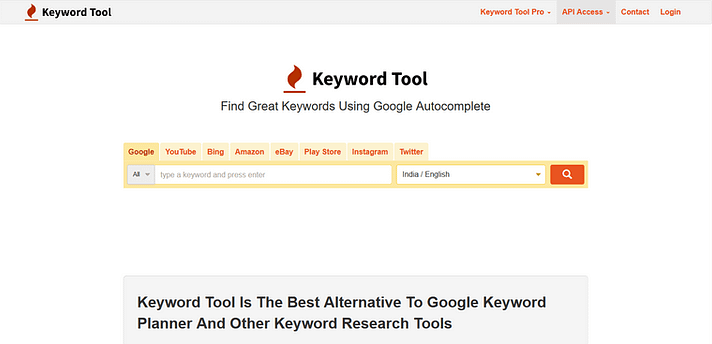
If you’re obsessed with keyword data mining, try Keyword Tool. The platform is regarded as one of the top keyword research tools on the market and offers analysis for multiple search engines including Google, YouTube, Bing, Amazon, and the App Store.
Standout features
Find great keywords using Google Autocomplete
Supplement your social media marketing with Instagram and Twitter keyword analysis
Export results to CSV
Simple UX for beginners
Pricing
Keyword Tool is very similar to Google Keyword Planner. It’s free for first 750+ keywords and extremely easy to get started with. The Keyword Tool “Basic” plan starts at $69 per month and is billed annually.
9. Serpstat
If you’re searching for a full SEO suite, Serpstat is an excellent option which combines website analytics, keyword research tool, SERP analysis, backlink analysis, a rank tracker, and website audit features. It’s an all-in-one solution meant to streamline the entire category of SEO.
Standout features
Know your competition using the competitor graph feature
Find keyword difficulty and keyword trends
The most budget-friendly option on our list
Pricing
Similar to a couple of the other options we’ve listed here, Serpstat can be used a few times for free by signing up for their trial membership. To use the service regularly though, you need to get yourself set up with one of their subscriptions. A personal plan goes for $55 per month.
10. Moz Keyword Explorer
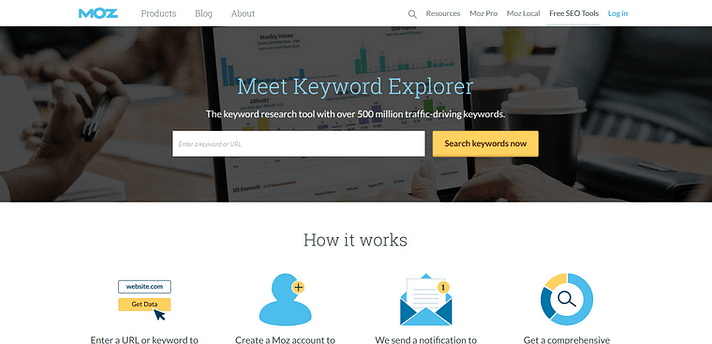
The Moz Keyword Explorer serves up easy to use, out-of-the-box keyword recommendations. Moz’s SEO tool boasts all the features you’d expect from the very best keyword research tools, plus two very unique data points.
Organic CTR score – This click-through rate demonstrates the number of clicks you’re expected to attract on page 1 of Google.
Priority score – The priority score is a mixture of all the individual factors a typical tool uses to suggest keyword options. It combines data on CTR, search volume, and keyword difficulty to help you select the best terms for your project.
Standout features
Get related keyword suggestions
Organic CTR and Priority score for smart targeting
Moz offers a one month trial period
Pricing
Sign up for a free Moz account and get 10 free queries per month. The Keyword Explorer is not a standalone researching tool, to get full access to this useful little asset you will need to pay for the entire SEO suite. You can get the Moz keyword research features in the platform’s “Medium” plan, which starts at $179 a month with the option for a free 30-day trial.
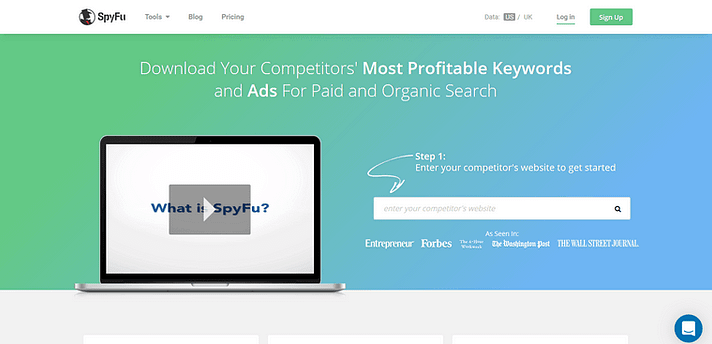
11. SpyFu
SpyFu is the #1 choice for analyzing your competitors’ SEO strategies. Their keyword tool uncovers valuable, virtually untapped keywords and makes a huge difference if you’re working in a highly saturated niche.
Standout features
Compare different websites competing for a single search term
Discover ranking difficulty and historical rank changes
Additional modules for in-depth domain analysis
Pricing
SpyFu is a little different from the other tools we’ve listed here as they offer monthly results, not real-time feedback. You can subscribe to SpyFu for $33 per month if you choose the annual billing option.
Which is the best keyword research tool for you?
These are some of the best keyword research tools you can currently find in the SEO marketplace.
To find the one that works for your business, start by analyzing your budget and then consider the primary focus of your brand’s SEO strategy.These 10+ keyword #research #tools will help you start ranking your #content in #Google CLICK TO TWEET
If budget is your chief concern, narrow your search to Google Keyword Planner or Serpstat. If you need a more robust set of tools, you’re going to be looking at KWFinder, SEMrush, or Moz Keyword Explorer.
There are many ways to earn money online and in those ways one of the top and famous way is Affiliate Marketing. Now for beginners it may be a question, How to start Affiliate Marketing of Amazon Products. Usually beginners, who are interested in making money online from Amazon Affiliate Marketing start with Amazon Affiliate program and keep searching on How to start Affiliate Marketing of Amazon Products but sometimes they don’t get the right answers to their questions.
But in this article you will learn about How to start Affiliate Marketing of Amazon Products from very beginning to advance step by step with less investment. Now if you are a beginner and wanted to make money online from Affiliate Marketing then you should read this full article about How to start Affiliate Marketing of Amazon Products of Amazon and become successful by following these 8 major steps.
Table of Contents
What is Affiliate Marketing?
In a very simple language Affiliate marketing is a marketing in which a person promotes the products of a particular company and earns a certain amount of commission on each sale. There are many Affiliate programs of different companies such as Amazon, Flipkart, Clickbank etc, available on the internet, which you can join and make money online from Affiliate Marketing.
How To Start Affiliate Marketing
Starting Affiliate marketing is easy but becoming a good affiliate marketer is a bit difficult, so if your start is good you will become a good affiliate marketer. Before starting affiliate marketing first you should decide which company affiliate program you are going to choose. For beginners the first choice is Amazon Affiliate Program as it is easy to do and become successful earlier. Before starting Amazon affiliate marketing there are some major steps that you must follow to become successful earlier in Amazon affiliate marketing as if your start is good then you will last for long. You just need to first create your Amazon affiliate account for free and then start affiliate marketing of Amazon Products.
Amazon Affiliate Program Commission
This is the most important part that you must know before starting Amazon affiliate marketing: how much commission you will have on the sale of one product. Now this is not fixed, Amazon has divided all the products into some different categories and gives you commission on the basis of product’s category. There are different categories which have different commission rates. You can check commission rates of different categories by visiting the Amazon Affiliate Program commission web page.
Where To Promote Amazon Products
Before starting amazon affiliate marketing, you first have to decide where you are going to promote Amazon Products. Now it may be a good question, as if you will choose the wrong platform then you will suffer. Now beginners will think to start affiliate marketing with some of their social media accounts or with YouTube, you can do this but this will not give any success in affiliate marketing and you will not be able to become a good affiliate marketer and make money online in affiliate marketing.
The only good and working way is to start affiliate marketing by making your website/blog or by making your application and promote Amazon Products. Making a mobile application will cost you a lot if you are a beginner, therefore the best way to start affiliate marketing by making your website or a blog. Making a website includes 8 major steps that you must follow to make a good website and make money online in affiliate marketing.
Step:1 Choose A Niche
Before starting Amazon affiliate marketing, you first have to choose a particular niche or a category and promote that particular category Amazon Products. For example, I am making one website in a particular category say ‘Computer Accessories’, then I have to add computer accessories products in my website such as printer, keyboard, mouse, hard drive etc. So you also have to choose a particular niche of your website and start adding products in your website. Working on a particular niche website will give a professional look to your website which will help to attract people to your website. The more traffic you have on your website the sale you will get and earn commission.
Step:2Buy A Domain Name
The next major step is to buy a domain name for your website. You can buy the domain name of your website on any platforms such as Godaddy, Bigrock, Google domains etc. But before buying a domain name you should check first whether your domain name is suitable for a website niche. For example, if your website niche is computer accessories, then you should choose a domain name related to computer accessories. This makes your domain a professional domain which is suitable for your website. Now it’s your choice which extension domain you want. For example, .com, .in, .net etc. Everyone’s first choice is .com but if it’s not available you may go for other extensions.
Step:3 Purchase A Hosting
The next step after buying a domain is purchasing a hosting. You have to choose on which platform you want to host your website. There are many platforms available on the internet which provide you free hosting as well as paid hosting. If your budget is less than you choose free hosting and you will get on various platforms such as 000webhost.com, infinityfree.net, freehosting.com etc. But for a better hosting you may go for paid hosting which you will get on various platforms such as WordPress, Godaddy, Bigrock, Hostinger, Bluehost etc. So it’s up to you which platform you want to choose to host your website. Also, if you want better hosting but for free you may choose Blogger. The hosting provided by Blogger is very good and you also get SSL for free with a subdomain of .blogspot.com.
Step:4 Install WordPress
After purchasing a hosting or choosing free hosting platforms, the next step is installing wordPress. wordPress is a platform where you can make dynamic websites. So, wherever you host your website you should install WordPress to make your site more dynamic and customize according to your way simply by just drag and drop. As WordPress offers you to make awesome websites without coding, you can make it just by drag and drop.
Step:5 Install theme
After installing WordPress the next major step is to install a theme which will make your website more dynamic and attractive. There are many themes which you will get on wordPress for free. You can choose a theme which is more suitable for your website. If you don’t like any of the themes in WordPress then you can download your theme from an external source and upload it on WordPress. You can choose free as well as paid themes from an external source. There are some paid themes which are more dynamic, so it’s on your budget either to choose a free or paid theme.
Step:6 Customize A Theme
After installing a theme it is compulsory to customize it properly which suits your website more. WordPress offers you more customization options and gives you the right to make a dynamic website just by drag and drop. You can easily customize your theme in WordPress such as customizing headers, sidebar, footer, changing colour of any part and many more. If you have started affiliate marketing in Blogger then may get more customization as you are getting in WordPress.
Step:7 Start Adding Amazon Products
Once you have installed and customized a theme then the next major step is to start adding Amazon Products. You have chosen a category then start adding products of that category in your website. You can add products in two ways either by manually or with the help of a plugin known as Woocommerce. Woocommerce is a paid plugin, which beginners will not be able to purchase, so for them there is only one option to add products in their website and that is they have to add manually. Manually they have to add images and some product’s content and description and manually they have to paste their affiliate links.
Step:8 Start Building Website Traffic
Once you have completed making your website and have added products, the most important part is website traffic. If there will be no traffic on your website then you will not get a single sale and if you will not get any sale then you will earn commission from Amazon affiliate products. So, it is necessary to build traffic on your website. Now you can build traffic on your website in two ways, one is organically through search engines and the second way is to build traffic from social media or by creating Backlinks.
Building Traffic Organically
The best way to build traffic on your website is organically through search engines.This process may take time to build traffic to your website but this is good for long lasting. By this method, the Domain Authority(DA) of your website will increase organically and this is going to benefit you. You can build organic traffic on your website by providing unique and good content in your website and by doing it’s white hat SEO(Search engine Optimization). SEO is basically an organic process to rank your website in the top results of Google or any other search engines like Yahoo, Bing, Amazon etc.
Building Traffic From Social Media
This method is also a legal and quick way to build traffic on your website.In today’s technical world there are many social media platforms from where you can promote your website or Business and make money online from it. You can use social media platforms such Facebook, Quora, Instagram, Pinterest, YouTube, Linked in etc. You can use these platforms to build a huge traffic on your website.
After making your website you can make pages and spaces of your website on these social media platforms and start sharing content of your website on these platforms and link your website with these platforms. There is a huge traffic on these all platforms so you can easily build traffic on your website. Nowadays people use social media just for entertainment purposes, but you should learn about how you can earn from social media by growing your Business with social media.
This is the complete detailed article on How to start Affiliate marketing with Amazon Products to become successful fast in Affiliate Marketing career. In this article you learned about what is Affiliate Marketing, how to start Affiliate Marketing of Amazon Products by making a dynamic website and also how to build more traffic on your website through organic ways by doing seo and also by social media platforms, by following these 8 major steps you can become a good Affiliate Marketer from beginning to advance and can make your career in Amazon Affiliate Marketing and Make Money online.
In this post, you will learn everything you must about Pay Per Click affiliate marketing, a type of advertising that pays a fraction of a dollar for each click. This is a great way to generate money online if you pull this off correctly.
Table of Contents
Why Is Affiliate Marketing a Great Way To Earn Money Online?
Affiliate marketing refers to the process of advertising someone else’s products and making a cut for each sale.
The types of ads that affiliates might use differ a lot. Affiliate marketing is usually subtle and the best marketers feel like they’re selling you a story instead of the affiliate product. This way, their audience gets invested in the story and before they know it, they bought something off of you.
Affiliates around the globe earn a lot with these tactics. Their content revolves around selling people clicking on their affiliate links pointing to products and services.
Keep in mind that affiliates aren’t the only ones raking in big bucks. The businesses that launched their affiliate programs are getting the longer end of the stick. They have to do almost zero marketing as they reap the benefits of the hard work their affiliates put in.
This is why they are more than happy to give affiliates big payouts — even paying those affiliates a lot is far more cost-effective than advertising yourself.
Most of the affiliate marketing strategies revolve around SEO and generating more organic traffic through content and backlinks.
What Is “Pay-Per-Click” in Affiliate Marketing?
Pay-per-click (PPC) marketing is a way to encourage website visitors to perform a specific action on your site to your affiliates in exchange for money.
For this to happen, site owners need to sign up for an ad network where they can feature dynamic ads or links on their site relevant to their topic. From here, affiliate marketing publishers can generate income if their visitors click on the ads.
This is a different affiliate marketing model compared to the one above. Instead of searching for affiliate programs to join and manually placing their links on your site, PPC affiliate marketing just requires you to paste a code on your site where you want the ads to appear on your site. From here, the ad networks will take care of showing the best ads to appear on your site to maximize conversions.
Ideally, the goal is to get more traffic to your site, leading to more clicks and revenue. However, and you’ll find out later, other PPC affiliate models allow you to make money without forcing people to click on your ads or links. In this case, it’s a matter of finding the best type of pay-per-click affiliate marketing for your website.
On the downside, the payout for PPC affiliate marketing isn’t very high as opposed to the traditional type of affiliate marketing. That’s why volume is important — you can still make lots of money from this approach but you must drive as many visitors as you can.
Setting Up Your PPC Affiliate Marketing Campaign
We’ve already mentioned what pay-per-click affiliate marketing is in a nutshell. However, there’s more than meets the eye with this marketing tactic. It’s a long-winded process that requires lots of research, creation, and testing to achieve your desired results.
Below, we break down the entire process of developing and launching a pay-per-click affiliate marketing campaign from start to finish. Even if you’re new to affiliate marketing, consider this as a crash course to making money online using this marketing strategy.
Choose a Vertical or Niche
If you have no idea what you want to promote or what type of site to build, you must identify what vertical or subcategory you want to be in.
For example, You want to work in the finance category, but you want to focus on refinance offers. Refinance is your vertical.
If you further specify it to refinance for people over 50 in Germany only, then that would be considered more of a niche.
The goal of “niche-ing” down is to find a small market you want to target with your campaign. Despite its size, this market is much easier to penetrate for you to carve a place for yourself.
When researching for a niche to target in your campaign, there are lots of questions you must ask yourself:
How many people are searching for them on Google?
How many and how big online communities are there about the vertical?
Are there PPC affiliate programs you can join and products to promote in this niche?
How competitive is it to rank for its keywords on organic search?
How much is the cost per click (CPC) for its keywords, i.e. how much do you have to spend every time someone clicks on your ad?
To help answer these questions, we can divide this section into three parts:
Keyword research
Most of the questions require keyword research to help you answer them properly before moving forward.
To be clear, by doing keyword research, you are looking for verticals that you can leverage using SEO. Since you’ll be looking at organic search data, you’re targeting keywords that people type in on search engines all the time.
This way, you want to fashion your site to rank on top of search results for the topic you’ll be choosing from here.
For starters, you must use tools to help you unearth the data pertinent to your niche.
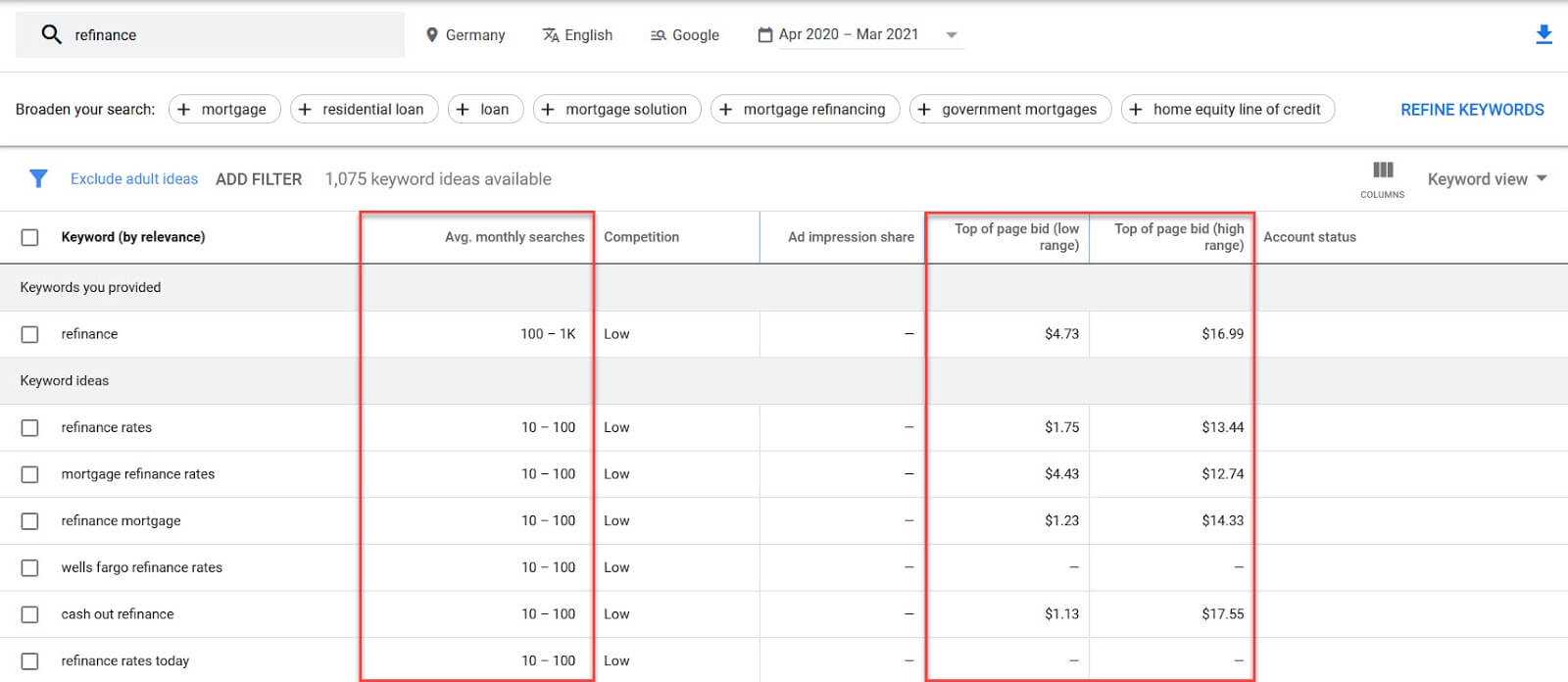
Google Keyword Planner is arguably the best tool you can use to find the range of monthly searches for a keyword.
Plus, you get to see keyword ideas and suggestions to help narrow your niche search.
The only problem with this tool is it shows you the range of monthly searches. For instance, there’s a lot of wiggle room for a monthly search volume between 100 to 1,000. As a result, you don’t get precise data that can help you plan out your campaign much more properly.
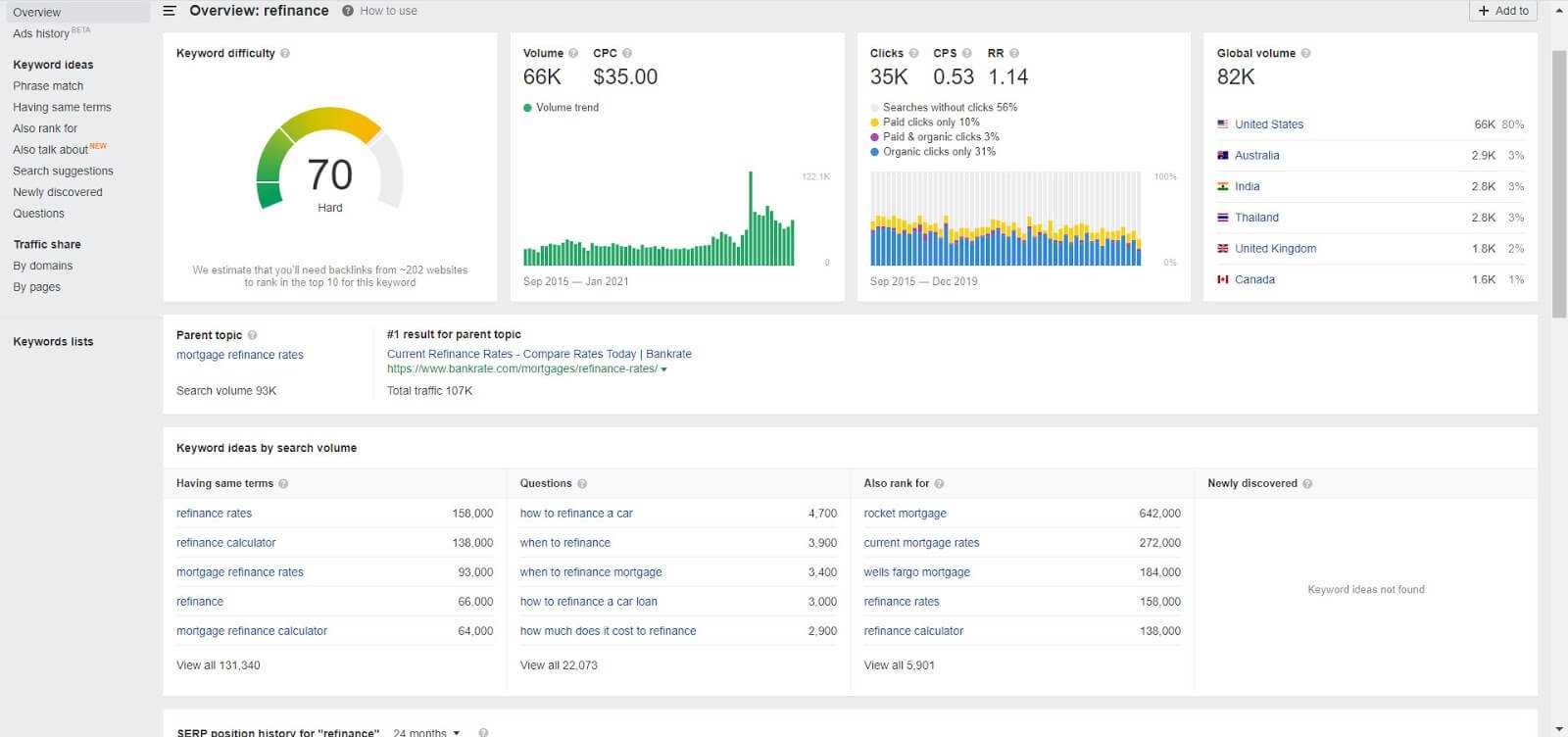
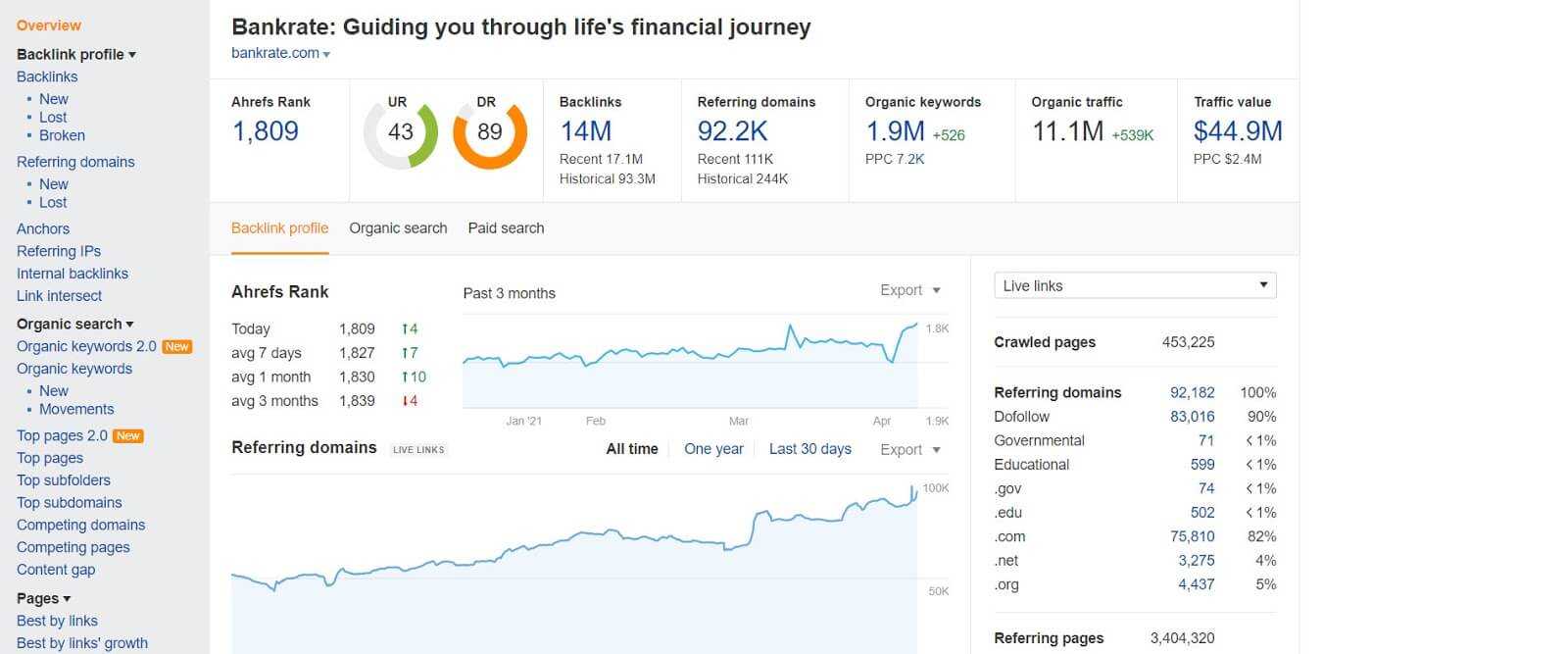
In this case, you might want to use a premium tool like Ahrefs to not only show you more precise monthly search and bid data, but also additional ones like keyword difficulty (for SEO).
The great thing about Ahrefs is its large database of keywords and websites. So when searching for keywords using the tool, you can be sure to find the most extensive keyword data in the market. This way, you can unearth more information about each topic and how “in demand” they are among search engines.
However, there are other keyword tools out there you can use. They arguably don’t provide the same level of quality and data, but you may find some much easier to use and has more affordable pricing.
Competitive research
Aside from learning about the potential keywords, you will have to target and bid as part of your niche selection, you also want the actual competitors you’ll be bidding against.
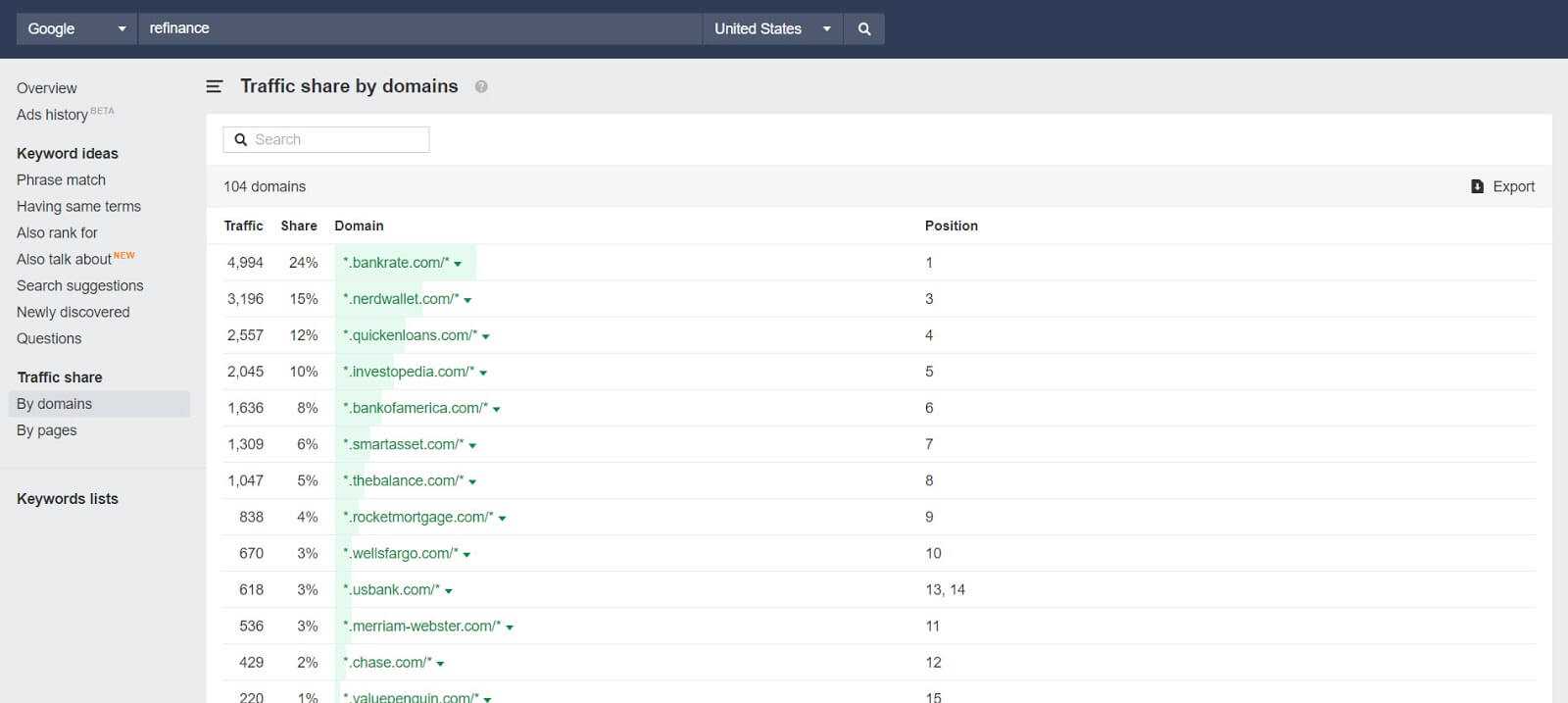
Ahrefs provides you a list of relevant sites regarding the keyword you entered.
From here, you can delve deeper into each site using each site by finding the best-performing pages according to the number of keywords it ranks for and estimated traffic from each.
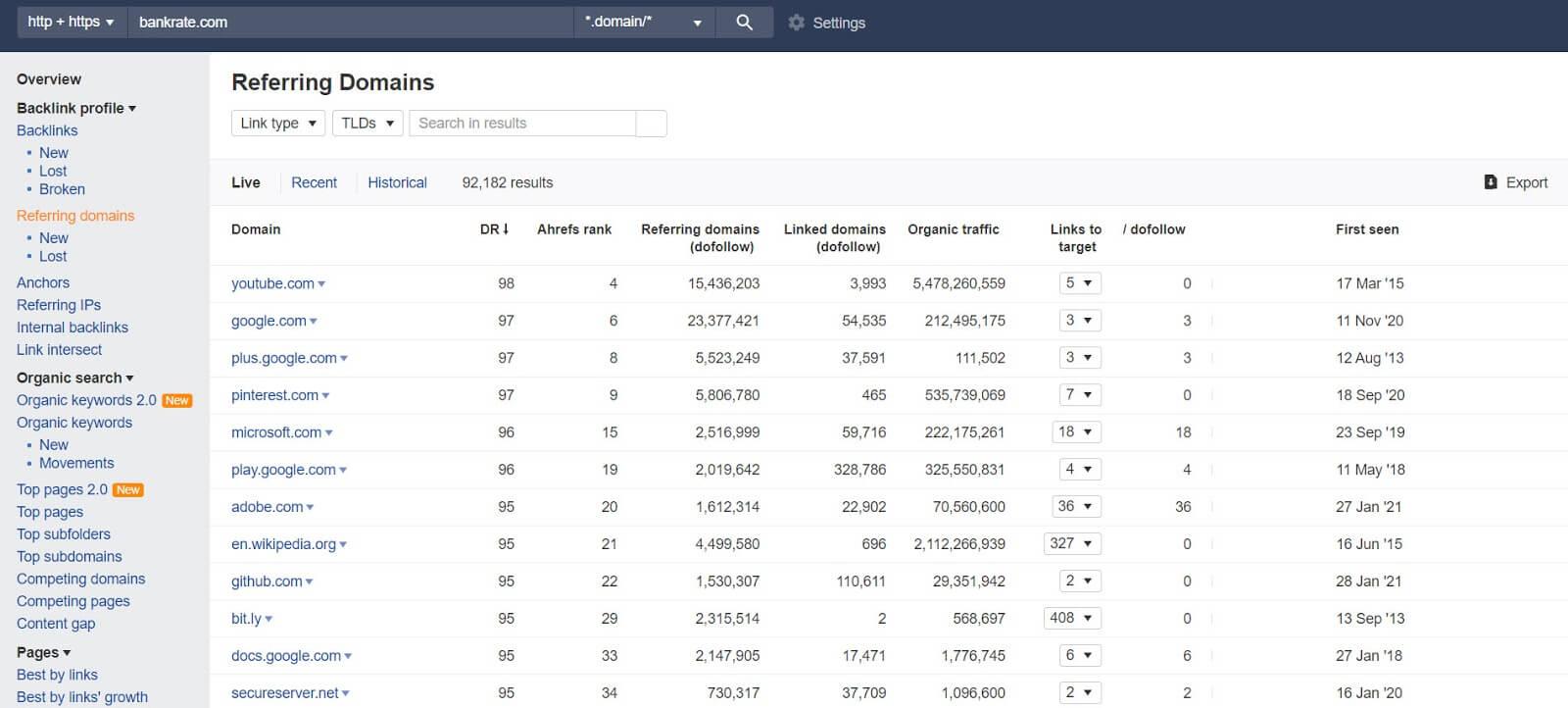
Part of your research should include analyzing the backlinks of each competitor to see what it takes to amass the same level of authority and ranking these sites have.
Ahrefs is again one of the best in this regard as it provides you with a breakdown of a site’s backlink profile according to referring domains according to different variables.
From here, you should see which domains your competitor has links to and how they were able to do. You could replicate their backlink profile later on whenever you’re ready.
Although you’re probably not going to be building links just yet, it’s good to at least export a copy of the referring domains of your competitors for future reference.
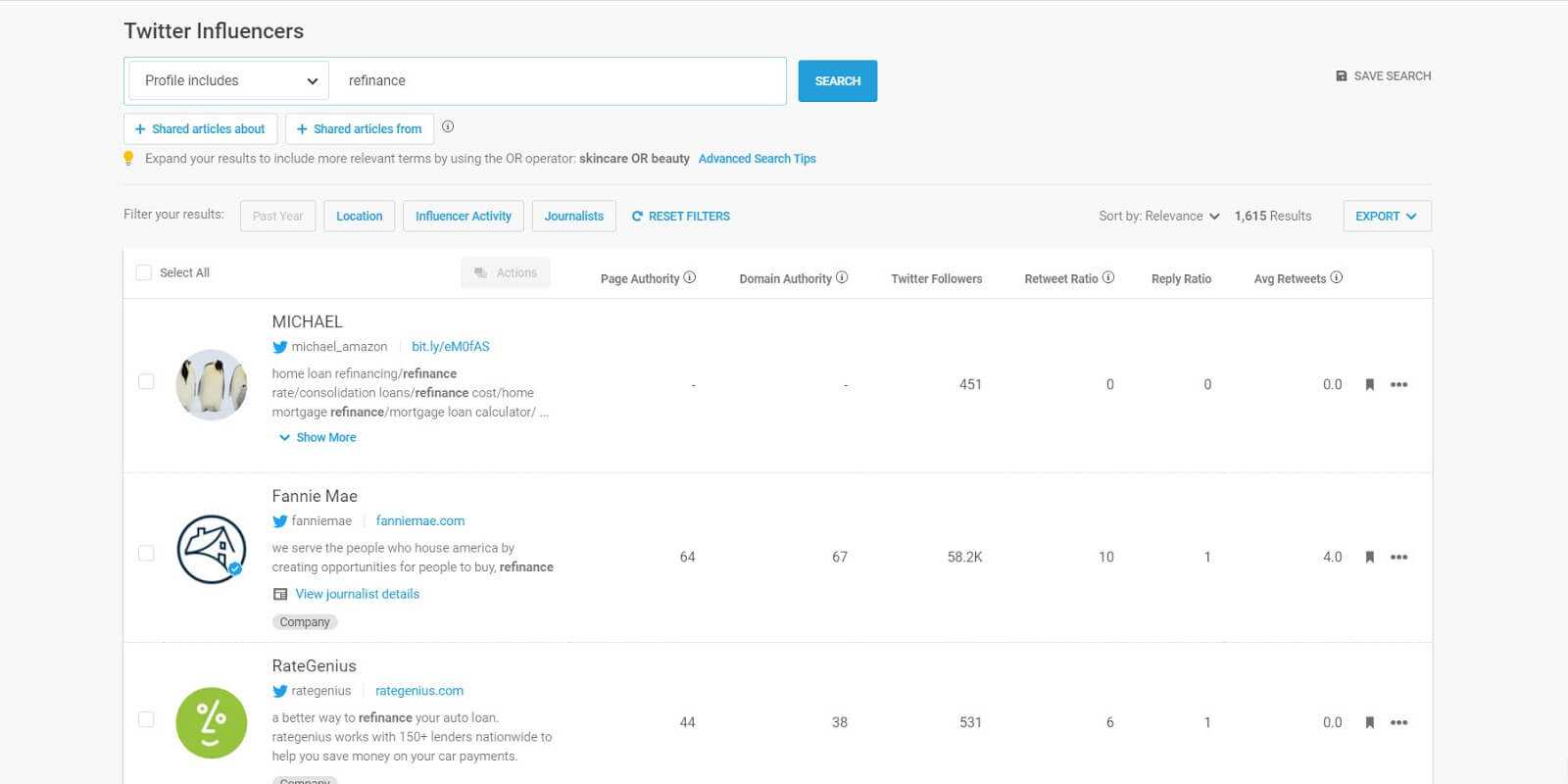
Aside from SEO, you should also research for competitors on social media. To do this, you’d need a tool like Buzzsumo that’ll allow you to search for influencers in the topics you’re interested in.
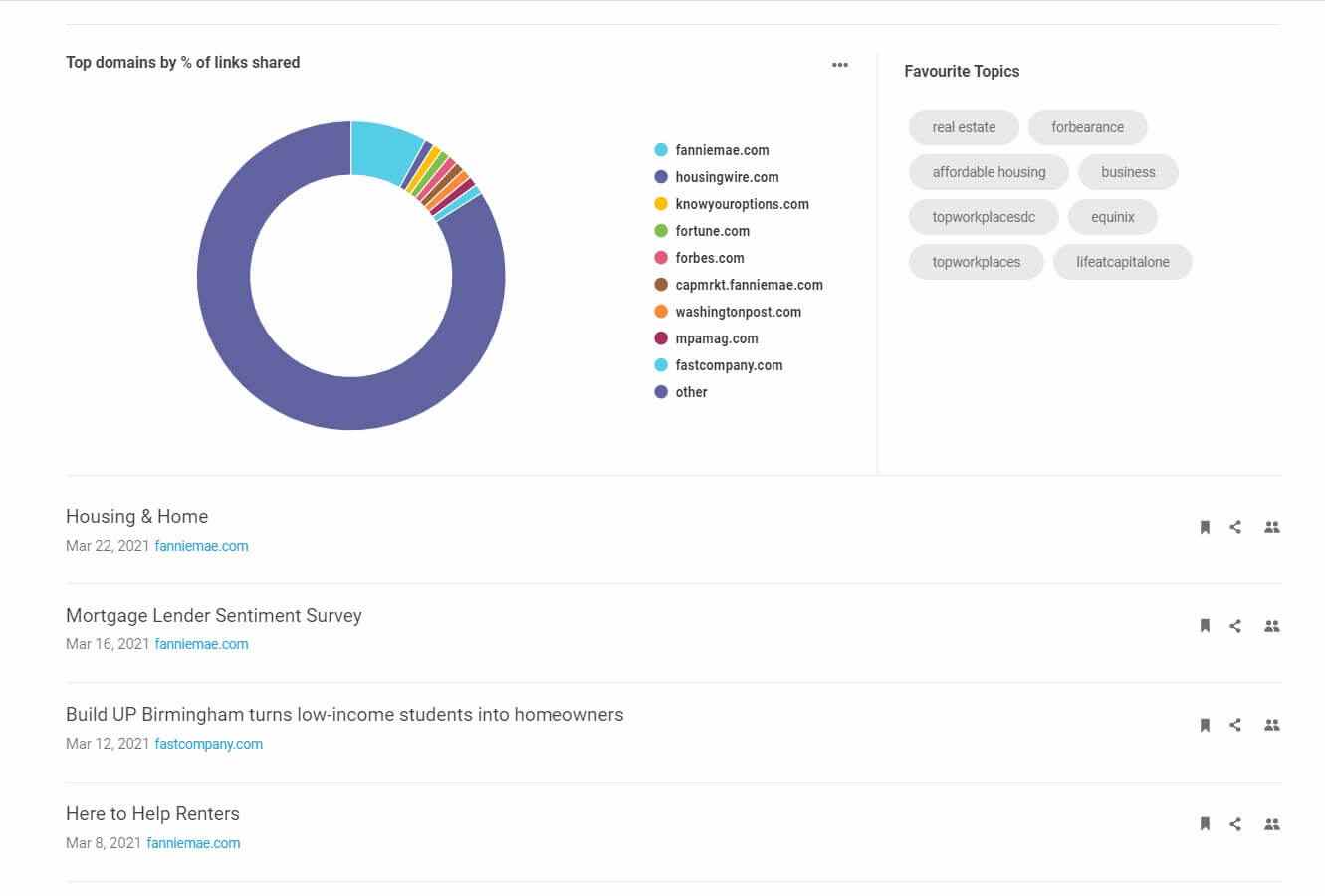
Look for influencers and authors on Twitter and YouTube that you want to track and analyze. The goal is to understand how they interact with their audience and the kind of content they share on social media.
Going back to niche selection, knowing how potential competitors leverage social media gives you an idea of how active and lucrative the topic is in this channel.
Research for online communities
Your keyword research would help unearth the interest and demand that the market has for the niche. The more monthly searches for its keywords and higher competition the niche has, the more cutthroat the demand and the competition are for it.
However, you can extend your research by looking at different online communities and the level of engagement they have about the niche.
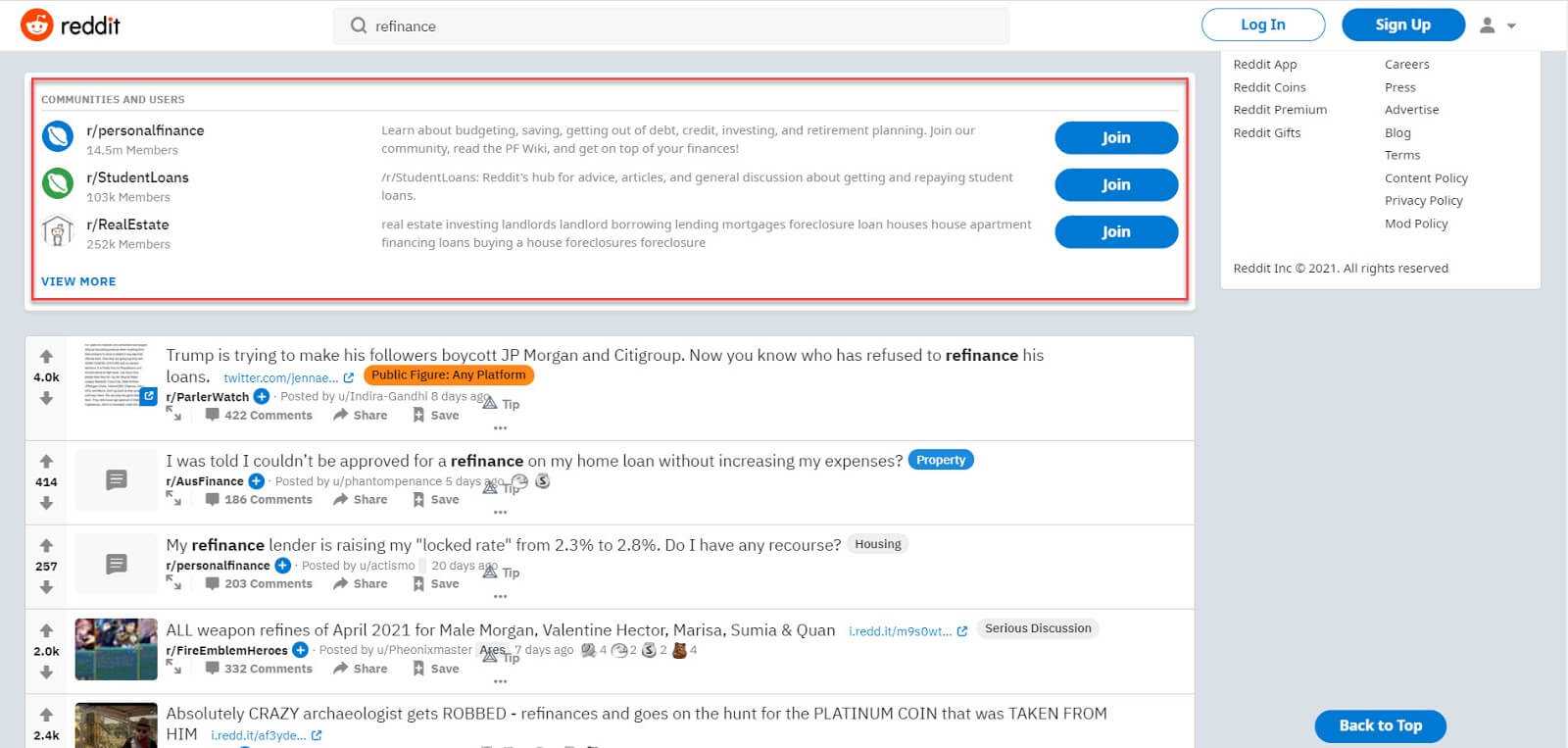
One of the best places where you could find online groups specific to your niche is Reddit. A quick search on the platform will show you subreddits relevant to your niche and posts that trace back to them.
You can then visit the subreddit and get the feel of its engagement. A subreddit with lots of members and with tens and thousands of upvotes on its most popular posts is indicative of an active subreddit.
Their activity shows you that there’s interest in your niche outside of the data provided by SEO tools!
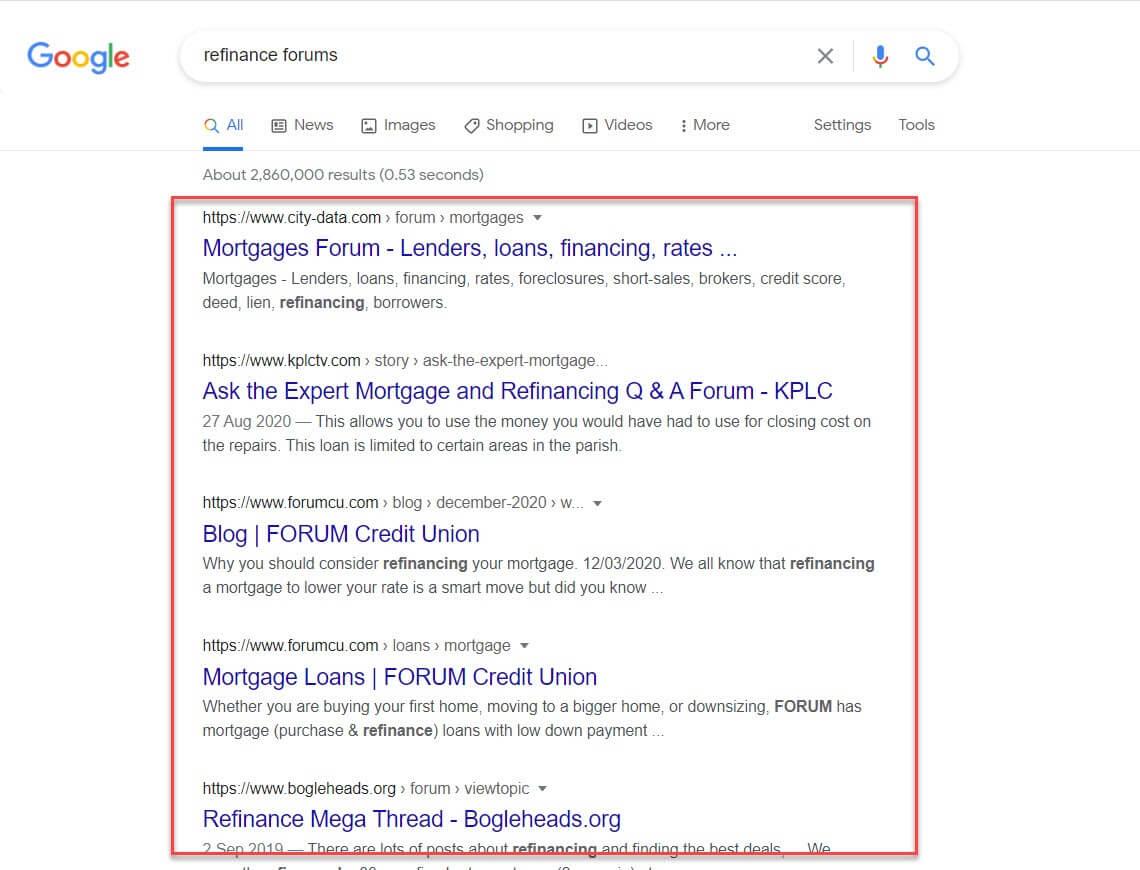
Another way to gauge the activity of online communities related to your niche is by doing a Google search for “keyword + forum.”
The results should show you forum boards related to your vertical. Similar to how you checked Reddit, see if the forums that appear on SERPs have thousands of members and generate lots of activity.
Find Pay-Per-Click Affiliate Programs to Join
If one thing for a niche to have a built-in community with lots of monthly searches for its keywords. It’s another to have lots of affiliate programs you can sign up and join to promote for your campaign.
Because if there are no programs to join despite being a “good” niche, then there’s no point in running a campaign for it!
When searching for affiliate programs to join and affiliate products to promote, you need to be wary of these things:
How much is the payout after every successful transaction? What’s the payment gateway for the payouts, i.e. PayPal, Stripe, wire transfer, etc.
Will the commission you’ll receive from the product a one-time payment or an ongoing one, i.e. monthly, yearly, etc.?
How long is the cookie life, i.e. how many days does the visitor have after visiting your page until you can earn a commission from purchasing the product?
How often will you be paid? Do you need to reach a minimum amount before you can withdraw your earnings?
Not all products will meet these criteria, but there are a few that almost do. Of course, all these factors vary depending on your vertical — some are not high-ticket advertisers and have much lower commission rates.
For new-ish sites, you’ll find yourself joining these ad networks that allow sites to low to medium traffic hits:
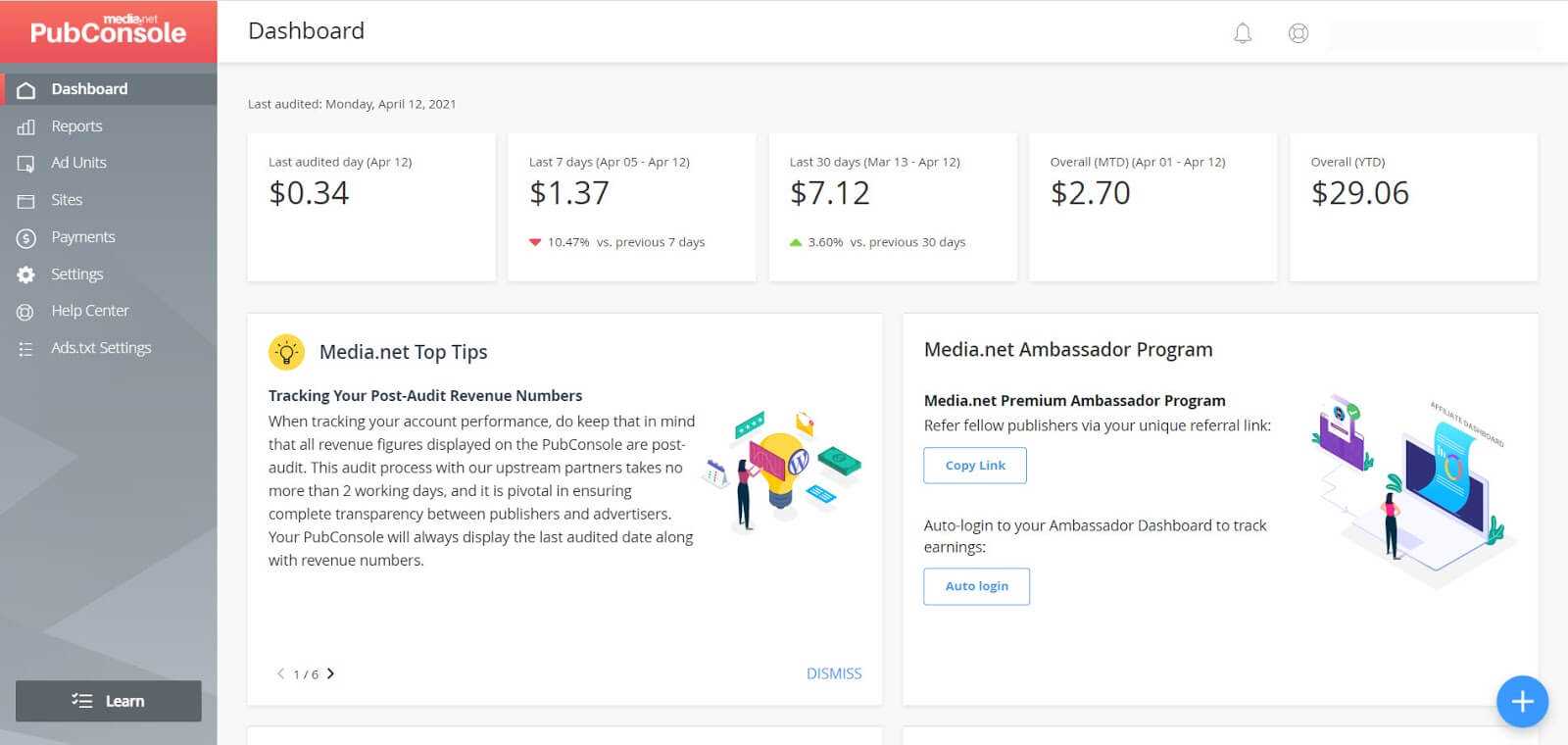
Media.net
RevenueHits
Skimlinks
Mintclicks
Bidvertiser
Due to the low barrier of entries to their display ad networks, you won’t be able to generate as much revenue from clicks and impressions as opposed to more premium PPC affiliate programs that have stringent traffic requirements.
During your search, you might be able to find an affiliate program model where the commission is paid when users take specific actions. These actions can be quite different. From forms to quotes, sign-ups, or even purchases.
Known as the cost per action (CPA) model, some swear that it’s the best way to monetize. While this might be true for some, it for sure isn’t that way for everyone. Their love for this type of affiliate marketing is because it is higher on the value chain (they get you more money basically) and that CPA integrates incredibly well into websites.
To find offers, you will have to do a bit of research first. You can find a CPA network that will give you a lot of offers that you can pick from. Some of the bigger CPA networks are:
ClickDealer
Maxbounty
CPALead
A4D
FireAds
And many more…
Create Your Website
Once you have a topic, you want to build a site where to house the ads that you will sign up for.
Much has been said about creating a site online. You probably even already have one — you may skip this step if that’s the case.
WordPress is one of the best website platforms due to its flexibility and ease of use. And among different hosting platforms, Bluehost is a great place for beginners to start with.
Define Your Goals
Ideally, the goal is to get visitors to click on your banner and text ads or perform a specific task concerning them if you’re using the CPA model.
Therefore, aligning your goal with the affiliate model you’re using is vital in curbing your expectations and scaling your campaign properly.
For example, if the goal of the PPC campaign is to attract more signups, then design your page to maximize the chances of meeting that goal.
Since you don’t have any benchmark to start with, how you position your campaign here will dictate the campaign’s progress moving forward.
Developing Your Content Strategy
Once you’ve decided on a vertical, it’s time to create content for your site!
You must go back to researching for keywords you can optimize on your website. Ideally, you want to target keywords with relatively high searches and low difficulty. This gives your content the best chances to rank on Google, drive more traffic, and generate more revenue from your display ads.
You can also leverage your content for sharing on social media for added traffic!
However, due to the complex Google algorithm, it’s never as simple as finding these keywords and creating optimized content for each.
Because even if you write the best articles for the keywords you found that meet your criteria, there’s no guarantee you’ll even rank for them on organic search.
Therefore, there needs to be a particular framework in mind to help structure the articles you’ll be producing moving forward.
A prevailing theory in the SEO space called the SEO Avalanche Technique calls for people to rank their site with limited to no resources.
That means creating content from the ground up based on the level of traffic the website is getting!
For example, if the affiliate website is generating 100 visitors a month, the owner must optimize for low-hanging fruit keywords with 100 monthly searches.
Over time of doing so, and once the site grows in traffic from 100 to 300, the owner will then need to optimize for keywords with a 300-month search volume.
Here’s a table of the levels and the monthly searches assigned to each level.
To determine which keywords to rank for, you need to use Ahrefs to locate keywords related to your topic with a KD of not more than 10. You also must filter the keywords you found using the tool with Doug Cunnington’s Keyword Golden Ratio.
From here, you also need to consider your internal linking strategy. By structuring how you link to each of the posts on your affiliate website, you can increase the topical relevance of your website on Google, thus improving its keyword ranking across all boards.
As the saying goes, a rising tide raises all boats!
Here’s an example of an internal linking strategy you can implement on your site in the form of content siloing:
Finally, upon publishing the sites, consider sharing them on social media to help with acquiring more traffic from them. There are social media automation tools that can pull out the latest content from your RSS and automatically share them on your chosen platforms like Facebook, Twitter, Pinterest, and the like.
Conversion Rate Optimization
After launching your campaign, you must wait over time to see how it performs.
There’s no single answer regarding how long you’ll have to wait before you conclude the campaign. It depends on the budget you’ve allotted for it, as well as your goals and benchmarks.
Once you’ve squeezed the most out of your campaign, it’s time to gather the data and analyze its overall performance.
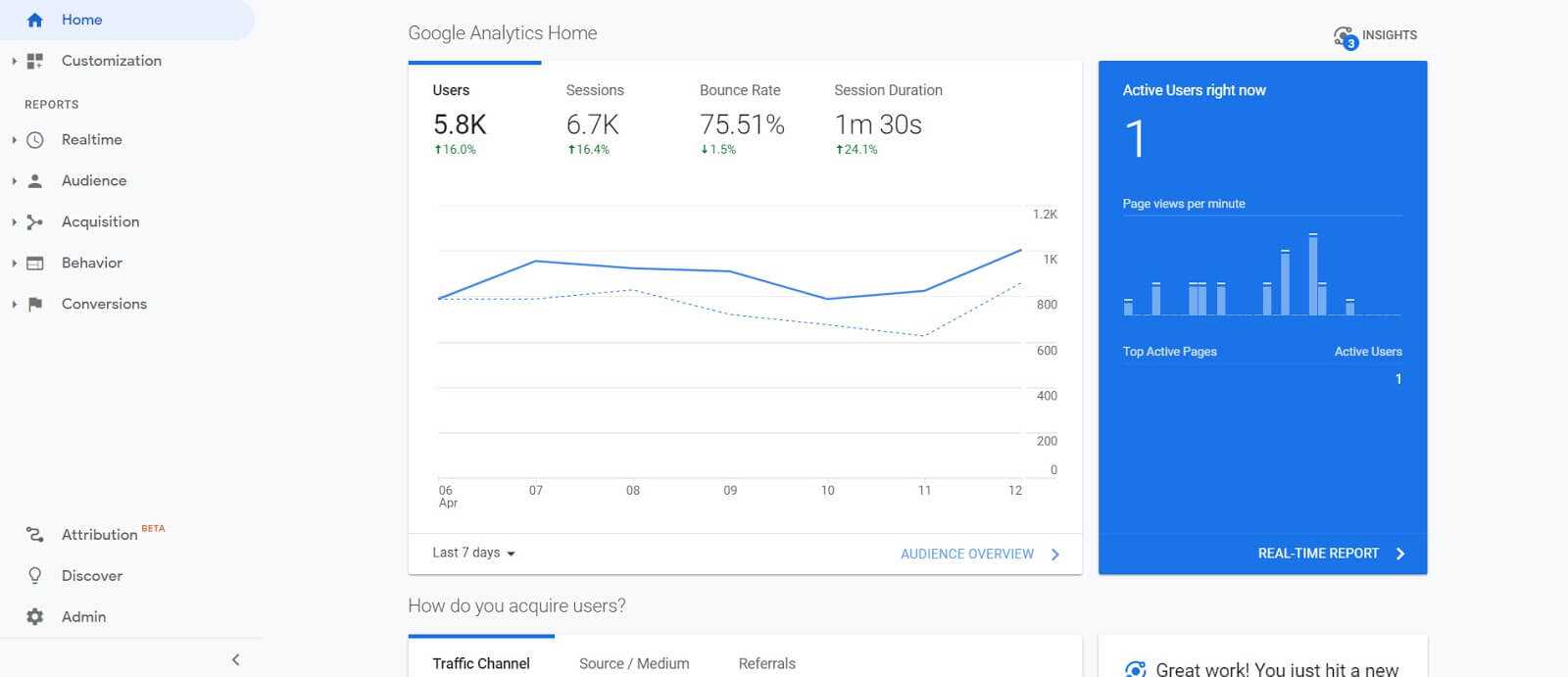
You’ll need to use Google Analytics for this. To do this, you need to install the code from your GA account to your website.
It shows you how many visitors you have, where they came from, how long do they stay on a page, and others. This helps provide context to how your ad campaign is faring so far and what you can improve to increase its performance.
From here, what you must do is identify your top-performing pages and monitor them closely moving forward. Consider them as your money-makers — since lots of people flock to these pages, they have the best chance of getting visitors to click on your display ads.
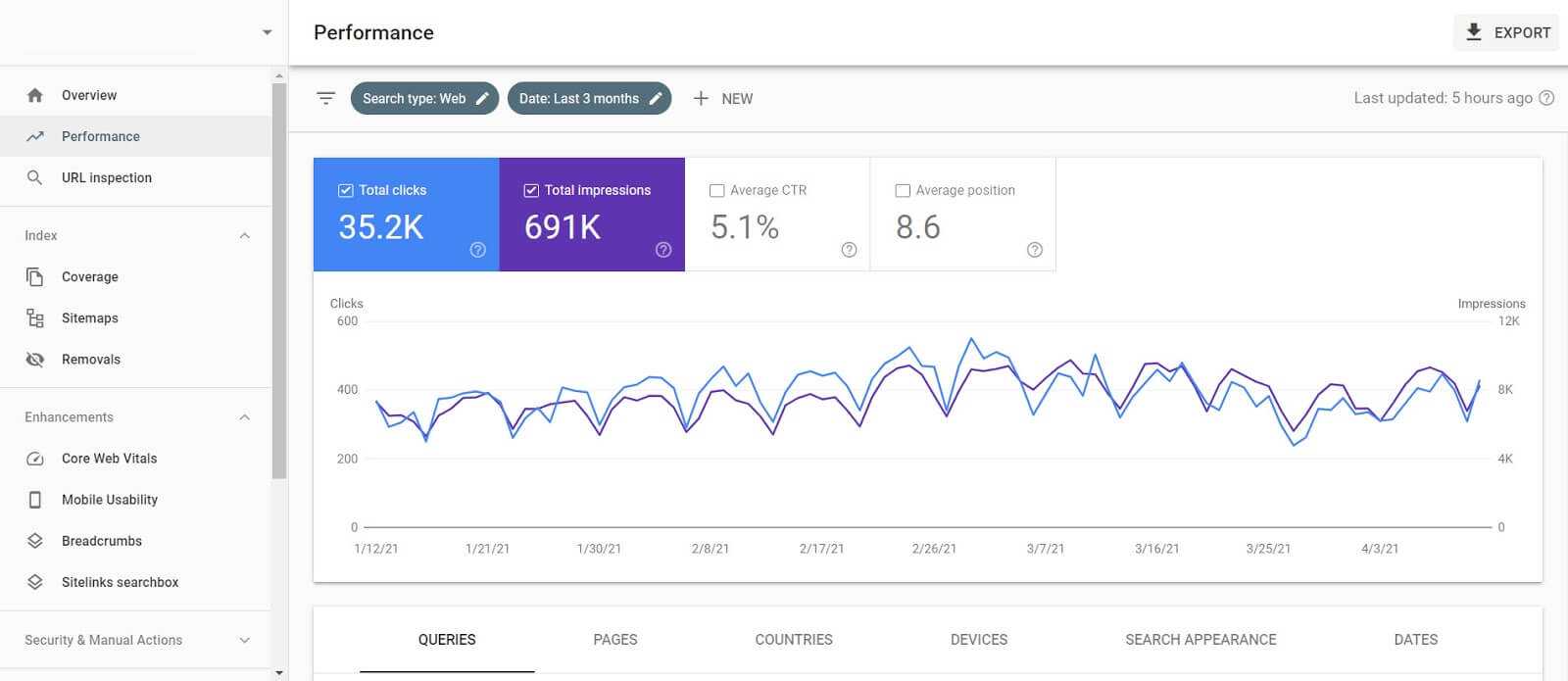
To help you give breadth to your Google Analytics data, you can also cross-reference it to your Google Search Console to see which keywords the pages are ranking for and the impressions of each page for their respective keywords.
At the same time, you need to check the dashboard of the affiliate programs you joined.
These will show you how much you’ve earned over time from the pages you’ve published on your website.
Similar to Google Analytics, you will see how much you’ve earned over time. You can then compare it to previous weeks and months to see a pattern or trend emerging from your campaign.
Using the data you’ve unearthed from these tools, you can gain insights into the following:
Which keywords are you ranking on top of SERPs for and for which pages?
What is your CTR percentage on SERPs? Is there a way to improve its overall performance?
Which page is helping you earn the most revenue from your affiliate programs?
Identifying these factors will help you scale your affiliate site’s performance much better.
If there’s anything to test on your site pages, it’s how many visitors browse through the majority of your pages. Most of the time, they stop before even reaching 50% of the page.
While it’s common for this to happen, what you want is to get more people to read your content.
To do this, you may need to rewrite the post and make it easier to read or move certain elements around to get more read-throughs on your page.
To effectively measure this, you need to use the Nelio A/B Testing plugin. Aside from running A/B tests, it helps you conduct heatmapping campaigns to see which part of the page visitors stop reading.
Also, if you’re generating a lot more traffic since you started, you are now eligible to apply and get approved to higher-paying PPC affiliate programs such as:
Google AdSense
Ezoic
AdThrive
Mediavine
The great thing about these programs is that, aside from their higher payouts, they help optimize your ads to maximize conversions.
By simply putting the code on your website, the programs take care of placing the display ads at relevant positions on your site pages. They will keep testing which parts of the pages the ads will appear to so you can focus on growing your traffic and creating better content on your site.
Top PPC Affiliate Marketing Tools to Use
As you can see above, PPC affiliate marketing is not for the faint of first. Since you’ll be dealing with bidding for keywords on top of extensive research and development, there’s very little room for error.
The last thing you want your campaign to be is a failure. And if it is, there’s no way you can get the money you spent on it!
Therefore, to help ensure that you run your campaign right from the start, below are other tools you can use to help jumpstart your ad campaigns for promoting your PPC affiliate programs.
At the same time, these tools make the process more convenient — you don’t have to manually do the research yourself since the software you’ll be using will do all the heavy lifting!
Below are some of the more popular tools you can use:
Adplexity — This is an intelligence tool that should be in every affiliate’s arsenal. This powerful tool will allow you to track your competitors and get inspired by their best ideas. Don’t spend money on endless testing and optimizing. Find exactly what works from the start!
WhatRunsWhere — This tool helps affiliates spend their advertising money smart. It gives you incredible insight into your campaigns and spendings so that you can better optimize your campaigns.
Voluum — If you want a state-of-the-art report tool, Voluum is hard to beat! They can track most things in real-time and give you incredible data points for each visitor.
AffJet — Managing your affiliate marketing campaigns is made easy with AffJet. It gives great insight into the performance of your campaigns. You can also get detailed statistics about each part of your campaigns.
Zeropark — Managing your campaigns doesn’t have to be a complicated task. With the Zeropark platform, you can quickly launch campaigns and optimize them on the fly!
RedTrack — RedTrack is similar to Voluum in a lot of ways, but it’s a bit more simple to use. It’s aimed at people who prefer simplicity and a tool that just works!
Conclusion
We’ve covered the basics of PPC affiliate marketing. From here, you should be able to get your affiliate website up and running after coming up with a vertical or niche that meets the criteria of being a profitable site if you play your cards right.